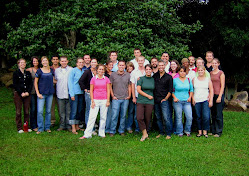
Hey friends and family! Thanks for e-visiting us. This is our humble site which we will attempt to keep updated (with limited internet access) with information on our lives, work and travels in Honduras and Central America.

Monday, October 29, 2007

Work, work, work

Hace mucho tiempo que les he escrito!!


Sorry for the long delay in a post. Things have gotten quite busy around here. The last couple weeks at work have had us working a full 8 hours a day (Yes, actually a full work day!) and then we have the added burdens of daily life here which easily fill up the extra hours in a day. Walking to the market and carrying heavy bags full of goods, washing laundry by hand, etc….all those things take more time than you think. Then, yesterday the SUEGROS (in-laws) arrived for a two week visit.


Several things are in full swing at work. The “vivero de empresas” project with the students of the Escuela Taller began 2 weeks ago. This is the business training program that Javi and I designed to teach 30 kids with carpentry, metal work and electricity backgrounds the fundamentals of business. This summer we were busy arranging the methodology for how this program was going to work, and lining up Honduran organizations to deliver the business classes. {We could teach it, but I don’t think these poor kids want to listen to MY Spanish for 4 hours a day!!!} Our counterparts at the Escuela Taller have thrown us for several loops (read last blog post) where things were changed at the last minute or we were not told vital pieces of information. But, the program continues and we are surviving the unforeseen bumps in the road. So far the students have been through a “How to get a job” orientation and an introduction to business and now are in a 4 week program where they will make business plans based on their skills and the products/services that they can offer. Our role through this time is to assist after class hours to answer questions and help students who might be falling behind in the curriculum. These kids are 16 – 20 years old, with varying levels of education from some of the poorer areas of Comayagua, so concepts like target market and fixed/variable costs don’t always come as easy. Our next step with this project will be to help arrange the “Feria de Productos” (Product Fair) where they will show off what they can make and manage it all with their new found business skills in Comayagua’s annual town fair, the first week of December. After that, we will wrap up the education side of the program, and the kids who want to stay will have the option of selling their products and services through the school in a small store. We also are supposed to set up how the shop will function, which is another project on our plates right now.


Here is a picture from one of the sessions that Javi and I coordinated. We set up mock interviews and prepped the students on how to give answers to key questions. This student (one of the “tougher guys”) is nervously sitting though his first interview:


At the Chamber of Commerce Javi has been busy helping our university interns organize their work for upgrading the website. Although he is no webmaster, he is good at organizing people and ideas and he is great at getting people motivated. I have been working with the interns to upgrade the Chamber’s business resource library, which has not seen much attention in a long time. Most of the information they have is old and a lot is not very relevant to the needs of the community, so this has been a challenge to upgrade the content without any money. I have been organizing the students to identify areas where we need new stuff and getting them to solicit the information. We also have someone creating a digital database of the library’s content.
There is also the world map project I have been doing in a small town school near here which is almost finished! Its been a pain in the arse to get out there every Wednesday afternoon, since the buses that take you there are not always running. I never know how I will get to and from Valle de Angeles where the school is; usually a combination of bus, walking, waiting on the side of the road or catching a ride with someone. But we are down to painting the last countries which hopefully can be done in one more session. I will post the finished product when we are finally done.


Conor, our site mate who works in health has asked us to attend meetings for a group he works with, a group of people who live with HIV/AIDS. They would like to think of ways to generate funds to pay for transportation for some of the harder up members (who cannot pay the bus fare to get to the meeting in Comayagua) and would like to generate some money to pay for prescriptions and other expenses if possible. We have only gone one time, so we will see where the group takes us.

And now we have the in laws visiting as well, although they are pretty low maintenance. Mostly they are interested in seeing our lives here and what we do, so we don’t have to spend too much time entertaining.

Here is a photo I took today of Deb, Jesus and Javi in front of Comayagua’s beautiful cathedral.


I am trying to get something together to post about Honduran emigration to the States which is a HUGE issue here. I will post that soon.

Hasta pronto!

Monday, October 15, 2007

The Roller Coaster Ride

Life can sometimes be like a roller coaster out here. The highs are so high, but the lows are so low. At first a lot of our ups and downs came with the living situation, but now we have control of that in our own comfortable house away from host families…the ride mostly has to do with work. (Who knows what else will be affected in the future.) We were in for a bumpy one this past week. Sometimes it can be SO FRUSTRATING here, where all can seem in vain and you wonder why you have left a good home to be here. Then there are times where you are connecting with people, ideas are flowing and you feel like some good is coming about from your being here. Phew……

I went to a meeting on Thursday here in Comayagua promoting the first year of the Millennium Challenge project in Honduras. The Millennium Challenge is one of many poverty reduction strategies of the UN, in Honduras focusing on training and education for farmers to help stimulate economic growth. My project director asked me to go (I wasn’t quite sure why while I was there) but I guess it was good to have a Peace Corps representative. The president of Honduras, Mel Zelaya, was there, and so was the US Ambassador to Honduras. If nothing else, it was very interesting to see the interaction between the Ambassador and the President and to see Mel speak. They were pushing lots of hoopla about how many farmers had been helped by the project, and there was lots of media attention and smiling politicians. Below is a picture I took (a bad one, sorry about that) of the ambassador and the president at the event. They are the guys in the black suits.
Now as a personal source of those numbers for such reports (we write how many people we “helped” in our 6 month reports we send to Washington), I wonder about those projections of results. It is hard to quantify results and “development” (as far as I’ve seen in my experience) is a pain staking slow process, requiring extreme patience. There are SO many international aid organizations here in Honduras, governmental and NGOs, with their signs and banners displayed all over buildings, flyers and programs in every corner of the country. Many of us volunteers have wondered….what would happen if they (and we) all just pulled out one day? What would Honduras and Hondurans do to make their country a better place? Would it inspire them to do it themselves and finally see some real results? Or would a country already on the brink suffer even more?

We ended this work week on a good note, after a few ups and downs on the roller coaster. This week we had a run in with people flaking out on us and people not owing up to the promises they made. Break downs in communications were a problem. Also - extreme procrastination and (dare I say it?) laziness. Things that we can take for granted at home, things that make things WORK and get things DONE.

Where does the complicated root of the problem lie? Why is this country (and so many others) so poor? Wow, that is a question I am not qualified to answer. Some that come to mind.....Hunger and poor nutrition, lack of access to education, disease, dirty water (or no water access at all), corruption, lack of capital, inept government, violence, general feeling of helplessness, centuries of exploitation by foreign countries, crumbling infrastructure, emigration…the list goes on and on.

Small successes are our personal goals as volunteers. We are each one person and can only make small (very small) impacts. Mostly these come with the few individuals that we make connections with at work. We can impart some of the skills and habits we have acquired simply from being American and coming from an educated and privileged background. Organizational skills, planning, and idea generation help, not to mention a free, college educated worker to help get things done in financially strapped organizations. And we are getting experience too. Not only all the organizing and planning skills I just mentioned, but exposure to new areas we are asked to lead and projects where we are asked to come up with ideas. Some of the projects we are asked to work on, we have absolutely no experience in and have no idea where to start, but we are the best they’ve got to get something done, and we give them the all we’ve got.

Now are you starting to understand the roller coaster????…..

Wednesday, October 3, 2007

La Primera Vez a la Costa Norte

Javi and I left Comayagua last Friday to spend a few days on Honduras’ north coast. Our official purpose for going up that way was to spend a few days in Tela to work on a peace corps business project. A group of nine volunteers met to work on a manual for a business simulation done during pre-service training for future volunteers in the business project. We had been putting the manual together over email and met to review and revise the first draft in person. We spent two nights in Tela but only part of one morning was spent on the manual, so it wasn’t too bad as far as “business trips” are concerned. (Getting to Tela takes several hours on the bus, thus the two night stay). Below is a picture of Javi and another volunteer, Marc, after we finished up our morning meeting.
Tela is a nice beach side town – Javi and I really liked it, and felt a twinge of jealousy because Tela is home to two lucky peace corps volunteers. Tela is small and relaxed with a mix of mestizo (what you normally think of as Hondurans) and Garifuna inhabitants.

Side note: Garifuna are black Caribbean people with an interesting story. They came to live on the Caribbean coasts of Belize and Honduras several hundred years ago after a series of historical events led them this way. The Garifuna are basically the product of Black Caribs (Native Americans from South America) and escaped/shipwrecked African slaves. They lived on the Caribbean island of San Vincente for many years where these two groups intermixed and created a unique race with their own language, dance and music, food and customs. They were deported off the island by the English in the late 1700’s to Honduras, where they established communities all over the Honduran North Coast region. Most speak Spanish, but there are still isolated communities where they only speak Garifuna.

Long before the Tela trip was to happen, Javi and I had been discussing checking about a national park near Tela called Jeanette Kawas (named after in advocate who was assassinated for working to save the park from developers). This park has a peninsula called Punta Sal, where I had read you could camp on the beach. After Tela, we made plans to camp two nights on Punta Sal with our friends Sean and Kate. We arranged a combination of taxi and boat travel to reach the peninsula (only reachable by boat) and made sure we had enough food and water. We were told two families lived on the peninsula on the beach, so we would be camping near them, and they could make us a few meals if we liked. The picture below is what we saw as we pulled up to Cocolito beach on the boat, where we camped.

Punta Sal, and especially Cocolito beach, was amazing. It is truly a very special place. The water was a clear green (like emerald) and combined with the green of the jungle it was absolutely beautiful. There was amazing animal life – we saw monkeys, tropical birds, colorful crabs, and some sea life (which we didn’t really get to see too much of because we unfortunately had no snorkel gear). We heard the monkeys howling in the trees within 30 minutes of getting there and were lucky enough to catch several glimpses of them, one time from the beach as we swam. The water was clear and warm, so we spent a lot of time in it. The first night when we sat on the dock after dinner, we could see glowing jelly fish swimming by. The second night, because the currents had taken away the jelly fish, we went for a swim where something beautiful and unexplainable happened in the water. Anytime you moved, glowing “sparks” of light would come alive under the water. They would stick to clothes and to hair long after you came out of the water and you could even see them sparkling on the beach. One of the guys who lived there, Alex, who was swimming with us that night said it was from the reflection of the moon, but we’re not sure about that. We couldn’t come up with an explanation for it, although I’m sure there is one.


Below are more pictures of Punta Sal:

It wasn’t all perfect at this place – in return for the amazing beauty and specialness of this place, you had to give one thing in return……bug bites. The bugs were relentless. Probably the most annoying were the sand flies – tiny, vile creatures that bit and left itchy red marks. When there wasn’t enough wind to keep them at bay we had to take refuge in the water. I fell asleep the second night to these guys biting me – they had found their way in the tent and would not let me fall asleep in peace. The second were the mosquitoes. The mosquitoes were so big, you could feel them landing on you. We all returned home yesterday with several HUNDRED bites from mosquitoes and sand flies that are still itching.

The usual way for the tourist to see Punta Sal is through a day trip from Tela, which is understandable due to the fact that the average tourist does not have camping gear, several free days to spend there or the inclination to put up with the bugs. We were lucky to pass a few days on Cocolito beach, not just to fully appreciate the place and see more wildlife, but also to hang out one night with Alex (who ran the restaurant) and the park ranger. Those guys told us stories and facts about the place, something the average passerby does not get to hear.
Leaving Punta Sal on Tuesday morning, we stopped in a traditional Garifuna village called Miami. Miami is built on a thin sliver of sand; on one side is the beach, on the other a lagoon. The four of us had a quick bite to eat on the beach. We had a friend with us as we ate, who was quite the ham when I asked him if I could take his picture with his pet crab. (Apparently I was not the first tourist to ever take his picture.)


Here is a picture of Miami from the beach side.


We made it back to Comayagua yesterday afternoon – tired, nasty from beach camping and covered with bites, but with a greater appreciation for this country that we are temporarily calling home.

Wednesday, September 19, 2007

Post script to "What we do"

Just FYI, the last post was not actually what Javi and I do personally. (Oh my God that would be crazy.) It is a list of what EVERYONE in the BUSINESS PROJECT (Honduras) does, which includes almost 30 people. I had a few people emailing me saying that we must be pretty busy down here with all those projects that we have going on. We have about 5 projects right now between the two of us. I'll write something about that later.

cheery-o!

Saturday, September 8, 2007

What we do

I wrote this summary a few weeks ago, after all the business volunteers (both old and new) got together for our the annual "reconnect" meeting. I know some of you may be wondering what we actually do down here as so-called “volunteers” in the very vague area of “business.” Maybe this will help clear some of that up. We all had to give brief presentations of what we are working on, so I took notes of what people's projects are.

I’ve arranged this list by project, versus person, since you wouldn’t know people by names and there is some overlap with some people working on similar types of things. Most people are working on more than one project. So, without further ado, THIS IS WHAT WE DO:

  • Support Caja Rurales (rural banks) and local Savings and Loans through trainings of members and staff in banking concepts and other types of organizational support
  • Website development including design, content and maintenance
  • Business Plan trainings, especially at the lower levels of Honduran society (ladies who make coconut bread or farmers for example). Javi and I are organizing a business plan curriculum to be taught to the students at the Escuela Taller here in Comayagua (we will actually end up teaching bits and pieces of it as well).
  • Marketing and promotion for artisan groups (including many native peoples) and local tourist initiatives.
  • Business simulations (like we did during training) for students in local middle and high schools
  • Computer classes for all age groups, from everything on “this is how you use a mouse” to advanced programming courses. One volunteer is developing curriculum for a high school computer class in advanced computing topics.
  • Supporting small business co-ops and groups on everything from trainings in how to organize and manage your business to support to find funding and get started. Many are women’s groups who make artisan goods or food items.
  • Needs analysis and strategic planning for start-up NGO’s
  • Implementation of databases (using excel) for organizations ranging from the local Health Center (to look up medical information) to collecting taxes at the local municipality
  • Support to local coffee growers – including promotion of their product and improved fertilization techniques
  • One volunteer is working with a water/sanitation volunteer to bring a landfill to his town (trash is currently thrown on a mountain side and is blowing into the town’s water source)
  • Support to business youth groups (marketing surveys, product improvement techniques)
  • Tourism development – including websites, tourist literature (tour guides, brochures, posters), cultural programming, even cutting trails for new ecotourism projects
  • Support for an initiative that wishes to turn trash collection into a small business, with recyclables being sold off and organic items being turned into fertilizer.
  • Building libraries in small towns and in schools. One volunteer has been recruited to become an elementary school’s part time librarian.
  • Solar ovens (not yet started)
  • AIDS charlas (lectures) to men’s only groups and school aged kids
  • One on one computer training
  • English classes
  • Local town newspaper published by high school students, taught through a computer class
  • Baseball teams
  • The “colgate” project (How to brush properly)
  • Why to stay in school charlas
  • “Odyssey of the mind” (creative thinking competition among school kids.)
  • The world map project (paint a giant map of the world on a school’s wall ---I am starting this one on Wednesday…..yikes! kids and paint!!)
  • Someone started a rugby team (is that really considered development?)
  • Pen pals programs with kids in the US
  • And….this one is great so I’ll put it last….one girl has started heading up “Ladies Night” at her small town’s new gym. This might not sound legit, but actually, educating about physical fitness and teaching appropriate ways to work out definitely has its place.

There were a few more….but I was getting tired of typing them up and ome were hard to explain in a single bullet point.

Honduras has six areas that volunteers work in. The other five are Municipal Development, Youth Development, Health/HIV-AIDS, Water/Sanitation, and Protected Areas Management. Other peace corps countries may have the same projects, or may have different ones depending on the needs of the particular country.

Sometimes day to day, you can feel as if what you are doing here isn't making much of a difference. But I was inspired (at least temporarily!) when we all got together and I saw what our project is doing here in Honduras.

Wednesday, September 5, 2007

Hurricane Felix

Well Javi and I thought we were in for our first hurricane, and a category 5 no less, yesterday evening. I checked the internet midday yesterday to see an image of a massive hurricane, the eye of the storm which was supposed to pass right over central Honduras! Mild panic and excitement set in!!


Up until that point, I thought the storm would only affect those on the north coast. We got a call from our project manager to tell us to "stead fast," or as we interpreted it, "hunker down," so we went around town in a frenzy buying food and stocking up on water. Hondurans, to the contrary, were pretty laxy dazy about the whole thing and continued on with their usual, laxy dazy pace. We figured this was due to one too many hurricanes passing through their country.

Anyway, after we were all stocked up, we waited. Some heavy rains came, but nothing worse than we had seen before. Turns out, (we found out this morning) Felix turned into a tropical storm by the time it hit land, mostly dumping rain on the swampy region that lies between northeastern Honduras and Nicaragua, the vast jungle wilderness of the Mosquitia.

Many had been comparing this hurricane to MITCH, a storm that wreaked havoc on Honduras in 1998, killing 11,000 (?) people and damaging the already feeble economy. I thought the most interesting part of the whole thing was when a guy at work told us that there were some people who were praying that the hurricane would bring that kind of damage, because then Honduras would get international attention again and the aid money would come poring in. That is crazy.

Another interesting antidote was a story I read on weather.com before we knew Felix would turn into a tropical storm. This guy had been evacuated from Roatan and was waiting for a flight back to the States. He was quoted as saying something to the effect that he hoped all this mess was worth it, because he had only gotten 7 dives in so far on his vacation, and he was a bit put out. SEVEN DIVES. And absolutely no thought for the rest of the people who actually live there on that island. Wow.

Well, thats all I have to say about that. Next time I will be posting something about the different kind of work business volunteers do here. Bye for now!

Wednesday, August 29, 2007

Parque Cental

We were out of town last week for the annual reconnect of the business project. Reconnect was a meeting of the PCV business groups of Hondu 8 and 10 which took place in a beautiful spot in the hills of Parque Cerro Azul Meambrar. We were initially not super excited about attending because of the all too close memories of times we had during training. Reluctant as we were about going (we had no choice as it is required of us) it ended up being a great experience gaining insight and new ideas from business volunteers from the class before us.

Reconnect added another benefit of allowing some friends a mas comoda (cheaper) opportunity to visiting us. They were our first planned on and “invited” friends to come and visit us in Comayagua. There are a handful of things for visitors to do here and most of it involves walking many hot hours around town. During the first half hour of walking around our group was separated resulting in the guys of the group looking for their wives for more than an hour.

After some time searching for them we ended up in Parque Central baffled about what our next step should be. Being off guard trying to come up with ideas of what to do, a crazy lady (very mentally ill person) who I have seen before around town, approached us slowly asking for “besos, pesos”, and then as nearing my chest “pechos”. This four foot something inch women attacked me, like a savaged animal with an open, mostly toothless, mouth going straight for my chest. She was trying to grab at my arms when in doing so made me turn back to her. At that moment she reached her hand into my rear crevasse area and jingled the family jewels. Keep in mind, Parque Central is a big plaza with the town cathedral in front of it. I turned around and told her trying to save face, “Basta! No enfrente de Dios!” A spark jumped into her eyes and she proceeded to go after each one of the three of us guys where we were so alarmed that we proceeded to high step around in a tight circle flailing our arms in all sorts of directions. In one of the circlings I caught a glimpse of other Hondurans sitting on benches in the park looking and laughing their asses off at us. Some how the gringo show ended and our lady friends, Sara and Kate, came strolling in to Parque Central minutes after the little psycho women had her way with us. I was extremely flustered from the incident and they were as calm and cool as could be excited about various used clothing prospects they had found around town.

In all we had a really good time with our first visitors, but plan on being more prepared for when family or friends come and visit us from back home, hopefully soon

--J